
Value Pick – August 9, 2026
Value Pick of the Week
I apologize for the length of this week’s post, but there was a lot going on — most of it good!
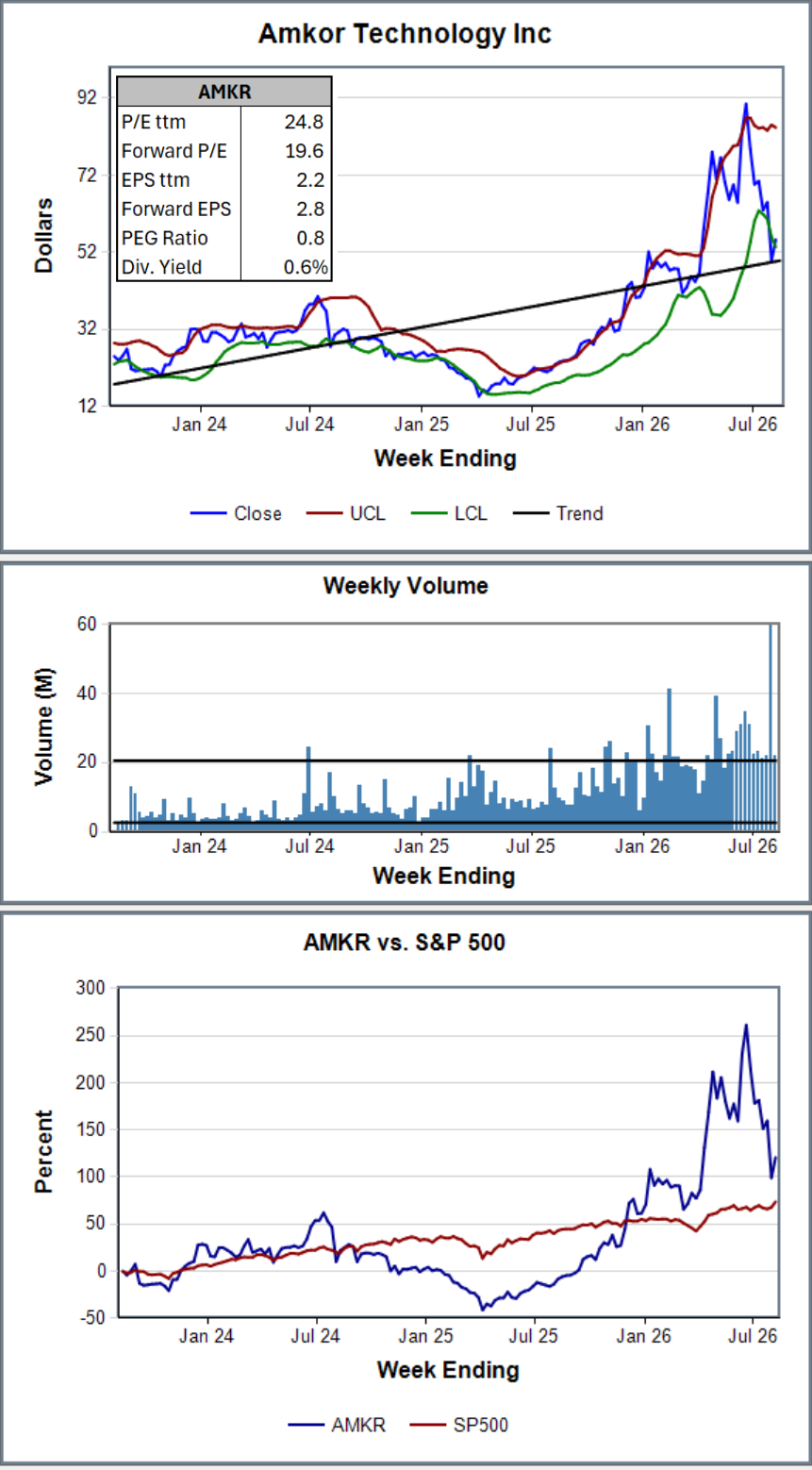
This week’s Value Pick is Amkor Technology (AMKR). Amkor is the largest U.S. outsourced semiconductor assembly and test provider (OSAT), packaging and testing chips for the world’s leading semiconductor companies — and while its AI/data-center computing business gets the headlines, most of Amkor’s revenue comes from elsewhere. Communications is the largest end market at 45% of sales, packaging chips for smartphones and tablets across both iOS and Android. Automotive & Industrial contributes about 20%, and the Consumer segment adds another 17%. In the most recent quarter, all end markets grew year-over-year, with automotive/industrial setting an all-time record (up 17%) — meaning even a slowdown in the AI buildout would leave Amkor with a diversified, growing core business tied to the broader electronics economy rather than a single theme.
-
Two anchor customer agreements de-risk the outlook — a 10-year advanced packaging agreement with Taiwan Semiconductor (TSMC) and a multi-year collaboration with NVIDIA (NVDA) represent a shift from transactional OSAT work to deep, long-dated partnerships with the two most important names in the supply chain.
-
Operating leverage is kicking in hard — Q2 revenue rose 26% year-over-year to a record $1.9 billion while EPS more than tripled to $0.70, as factory utilization climbed into the high-70% range. Utilization gains flow disproportionately to the bottom line in a capital-intensive business.
-
Management’s long-term targets imply substantial upside — guidance points to more than $11 billion in revenue by 2030 (versus ~$6.7 billion in 2025), gross margin above 22%, and EPS around $5. Analyst fair-value estimates have been revised sharply upward, from roughly $30 to $56+.
-
Capital returns alongside the growth spending — a shareholder-friendly $300 million buyback authorization and a quarterly dividend, even while committing $2.5–3 billion in 2026 capex, signals management confidence in cash generation.
-
Beat and drop — We’ve seen companies beat expectations and drop anyway on a number of occasions in our past picks — this time we’re on the other side of it. The Q2 2026 report (July 27, 2026) saw Amkor announce records by nearly every measure, beating expectations across the board, and their price fell 6.5%.
This would also be an opportune time to pick up shares of two Exchange Traded Funds we’ve discussed in the past: the Nasdaq 100 (QQQ) and the Defiance Quantum ETF (QTUM). Both of them met the basic requirements for a value pick this week. For more about those two funds, see https://therousehouse.net/investing-economics/qqq-qtum-wqtm/.
Market Summary
- The headline numbers were emphatic — the S&P 500 advanced 3.6% for the week, closing above 7,700 for the first time ever mid-week and finishing Friday at a record 7,757.64, up 0.62% on the day.
- Tuesday’s breakout ended a two-month consolidation — the S&P 500 ripped to a new all-time high on Tuesday, its first record following a multi-month sideways grind.
- Friday’s weak jobs report was the week’s decisive catalyst — nonfarm payrolls fell 23,000 in July with unemployment at 4.1%, and May and June were revised down by a combined 103,000 against expectations for 83,000 added roles. September rate-hike odds fell to 44% from 55% a day earlier, and the 10-year yield slipped to 4.639% while the 2-year fell to 4.193%, its lowest since July 17.
- Earnings season is running far ahead of normal — 436 S&P 500 companies have reported Q2, with 85% beating EPS estimates versus a 67% historical average; Q2 earnings growth is tracking +51% year-over-year, and 68% of analyst revisions over the past month have been upward.
- Middle East de-escalation eased the oil overhang — signs of progress toward reopening the Strait of Hormuz pushed oil prices lower early in the week, with October Brent futures falling more than 7% on the week.
- ⚠️ The valuation caution remains — the forward four-quarter P/E stands at 20.5, above both the 5- and 10-year averages, and with the index at a record, companies will need to keep delivering exceptional results to justify current multiples.
How Our Picks Fared
Our past picks had a good week also, beating the S&P 500 by 0.6% with a number of companies moving by more than 10% — 10 winners and 1 loser.
📉 Western Digital (WDC) fell 20.3%
- The week’s loser, and another “record quarter, stock crashes” story.
- Q4 FY2026 revenue was up 44% year-over-year and beat the consensus; gross margin expanded 13.1 points to 54.4%, and operating margin hit 44.2% versus 28.1% a year earlier — EPS beat the estimate by 7.9%.
- The guidance is what broke it. The company forecast gross margin of 55–56% and revenue of $4.0–$4.2 billion against a $4.04 billion consensus — a midpoint essentially in line, not the beat the market had priced — another case of the expectation not really being the expectation, apparently.
- Analysts split hard: Summit Insights downgraded from Buy to Hold, and Rosenblatt cut its target to $800 from $900, Mizuho to $590 from $685, and UBS to $525 from $560 — while TD Cowen went the other way, raising to $540 from $500.
- Context matters here: WDC was up 621% over the trailing 12 months at one point, so the stock had no cushion for anything short of perfection.
📈 Williams-Sonoma (WSM) rose 10.1%
- WSM hit a new 52-week high of $250.83 on Tuesday — its 18th new 52-week high in the past 12 months — with shares now up 39% in 2026 and 394% since a 5-year low of $50.79 in May 2022.
- The macro fit is clean: home furnishings is one of the most rate-sensitive consumer categories, and Friday’s weak payrolls report pushing rate-hike odds down is a direct tailwind.
- Margins have held up through tariffs — trailing 12-month gross margin of 46.0% is within a couple of basis points of any reporting period in the past 2–3 years, and CFO Jeff Howie has said 2025’s mitigation tactics should carry into 2026, with tariff refunds not yet in guidance.
📈 Ulta Beauty (ULTA) rose 10.2%
- Piper Sandler issued a Buy rating on ULTA during the week.
- The bigger driver looks like sector rotation off a depressed base — consumer discretionary is the only one of the S&P 500’s 11 sectors to decline year-to-date, and the dovish repricing after Friday’s jobs report is exactly the catalyst that lifts beaten-down discretionary names.
- The analyst consensus across 27 analysts is Buy with a 12-month target of $623.42, implying a 10.3% upside.
📈 Napco Security Technologies (NSSC) rose 11.5%
- A move of this size usually has discernible reasons, but not in this case — no earnings report, no changes in recommendations. Its classification in the Information Technology sector and its historic volatility could explain the jump.
📈 CrowdStrike (CRWD) rose 12.3% and Zscaler (ZS) rose 11.6%
These two moved together on a sector-wide cybersecurity rally, not company-specific news:
- Institutional investors rotated back into the cybersecurity sub-sector, with CrowdStrike’s Falcon platform continuing to gain share through module upselling and generative AI-driven tools bolstering long-term growth estimates.
- The AI-threat narrative is the structural driver — Palo Alto Networks launched Unit 42 Frontier AI Defense and CrowdStrike launched Falcon AI Detection and Response, both targeting AI-agent hacking threats; Dan Ives has predicted cybersecurity spending will double over the next three years — this would be in the forefront due to the recent incidents involving Anthropic and Meta AI agents hacking into systems.
- Price targets kept climbing: Morgan Stanley raised CrowdStrike from $172 to $227, Stifel from $220 to $230, and Citigroup from $195 to $250, citing new demand for its AI solutions.
- For Zscaler specifically, the falling rate-hike odds after Friday’s jobs report matter disproportionately — it’s the highest-duration, most beaten-down name in the group, and Wall Street sees the largest upside there, with a 12-month average target of $192.58.
📈 Nvidia (NVDA) rose 11.6%
- The company got a major boost after Elon Musk said SpaceX plans to build its AI infrastructure exclusively around Nvidia technology rather than AMD chips.
- The broader chip rebound did the rest — the Nasdaq’s 5.2% weekly gain was driven by exactly this bounce-back in semiconductors after weeks of correction.
📈 Dell Technologies (DELL) rose 11.9%
- Like NSSC, Dell didn’t report last week and the most likely driver for the spike is the same AI-infrastructure rebound that lifted Nvidia — Dell has been trading as a stand-in for AI server demand all year, and the sector-wide chip and AI recovery would carry it.
📈 InterDigital (IDCC) rose 13.0%
- A momentum re-rating following its guidance raise: Q2 2026 basic EPS came in at $4.51 on revenue of $260.2 million, and management lifted full-year guidance on both revenue and earnings.
- The move was a sustained streak rather than a single pop — eight consecutive up days producing a cumulative 26% gain and adding about $1.7 billion in market value, taking the market cap to roughly $8.3 billion.
- ⚠️ The caution flag: IDCC now trades at 27.6x earnings against an S&P 500 median of 24.4x, following a period where trailing twelve-month revenue declined 11.7% versus S&P median growth of 7.8%. Q2 revenue was actually down 13.5% year-over-year — the story is margin and ARR quality, not top-line growth.
📈 Oracle (ORCL) rose 13.2%
- A continuation of a rebound off deeply depressed levels — three catalysts stacked: the Google Cloud partnership announced July 30 integrates Gemini 3.1 Flash-Lite and 3.5 Flash into Oracle Fusion Apps and NetSuite, contributing to an 8.3% gain on August 3 alone; a 10-year Department of War contract worth $7 billion; and the $400 million OPM contract with CACI.
- Oracle Cloud Infrastructure remains the growth engine — FY2026 cloud infrastructure revenue surged 77% to $18.1 billion, 27% of total revenue.
- ⚠️ The bear case is still very much alive: capex ran to 174% of operating cash flow in FY2026, turning free cash flow negative, with a current ratio of 0.62 — and Michael Burry reopened a short position on Oracle during the week, while UBS lowered its target to $245 from $285.
📈 CACI International (CACI) rose 29.5%
- The week’s standout, on a blowout fiscal Q4: Revenue rose 17.6% year-over-year, beating estimates, with EPS coming in 23.2% above consensus; full-year FY2027 revenue guidance landed 0.7% above analyst estimates.
- Full fiscal 2026 revenue was up 10.9% with 7.2% organic growth, and free cash flow surged 68% on a per-share basis to $735 million — exceeding the three-year financial targets set at the November 2024 Investor Day.
- Analysts moved fast: Stifel Nicolaus raised its target to $892 on August 6, implying 38.3% upside, and UBS also raised its target citing consistent growth.
- A bonus catalyst landed Monday: CACI won a $400 million federal HR modernization contract at OPM alongside Oracle, Deloitte, and Baker Tilly.
Have a great week!