
Value Pick – September 20, 2026

Value Pick of the Week
No Value Pick this week.
Market Summary
During the week ending September 18th, the 0.1% weekly slide hid a lot of volatility. That −0.1% is the flattest-looking number this index has produced around a genuinely consequential week. It was a 1.4% slide into the Wednesday Fed meeting followed by a 1.3% bounce out of it. The market had put a 90% chance that the FOMC would raise the rate on Wednesday, and the first three days of the week saw the market slide ~0.47% each day. When the meeting came, the rate was increased but the future guidance was better than expected, and the market rebounded 1.3%, mostly on Thursday.
-
The Middle East supply story is a continuation from the prior week, but Tuesday brought something new inside this window: Saudi Arabia suspended loadings at its Red Sea port after Houthi attacks, taking a 4–5 million barrel/day pipeline offline.
-
Anthropic’s AI warning moved semiconductors. Anthropic CEO Dario Amodei’s call to slow frontier AI development, published on Saturday the 12th, dropped semiconductors 4% by the Monday open — unrelated to the Fed, and it’s most of why Monday was the week’s broadest down day. It’s why I always look at the market from Friday close to Friday close (ignoring holidays), because things happen over the weekend, and this past week is a good example of why it matters. Standard M–F commentary, including the Apple Stocks app, shows Monday open to Friday close, and the weekend is a mystery.
-
What the −0.1% conceals: Dow −1.7%, its worst week since March. Nasdaq +0.7%. That’s a 2.4-point spread inside a flat index — rate-sensitive and cyclical names took the hike squarely while large-cap tech absorbed it. Second straight week of that pattern.
-
A global tightening story, not a U.S.-only one. The Bank of Japan also hiked 25 bp to 1.25%, its fastest tightening pace in over 30 years, while the Bank of England held at 3.75%. Separately, Warren Buffett stepped down as chairman of Berkshire Hathaway (BRK.B) at 96, moving to chairman emeritus.
How Our Picks Fared
Our past picks gained 0.9% versus the S&P 500 during a turbulent, but ultimately flat, week — led by our two Software as a Service (SaaS) cybersecurity companies.
📈 CrowdStrike (CRWD) rose 15.0%
- Monday 9/14 did nearly all of it: closed around $232, roughly +12%, after trading as high as ~$237.57 intraday. Amodei’s essay argued that autonomous agent swarms could cause “hundreds of billions of dollars” in damage within 6–12 months, boosting cybersecurity in general.
- CEO George Kurtz worked the other side of it over the weekend — “the attackers had frontier AI, and the defenders didn’t. And that changes now” — following product launches at Fal.Con (Falcon Guardian, SafeMind, an Agentic Identity Provider).
- The stock set a record near $248 Thursday, then gave back about 4.3% Friday into the close.
📈 Zscaler (ZS) rose 19.9%
- Same Monday move — closed near $183.97, about +12% — but ZS kept climbing through Friday while CRWD faded.
- Some coverage attributed this to carryover from the September 3 fiscal Q4 beat-and-raise. I don’t think that holds, and the data is why: ZS traded near $178 on 9/4 and had already slid to $164.54 by 9/11. The earnings pop was spent before this window opened. What the September 3 quarter provided was the operating story — AI-security demand, raised guidance — that the stock could re-rate against once the Amodei bid arrived. The earnings are context; the AI-risk trade is the driver.
The pattern underneath both: money moved into cybersecurity as a thematic block, not on stock selection. Palo Alto Networks (PANW) +10% on the week, SailPoint (SAIL) +15%, Okta (OKTA) +9%, SentinelOne (S) +15% Monday. Cybersecurity was effectively the week’s only place to hide — this is the one corner of the AI trade that gets stronger when the technology looks more dangerous.
Past Picks Review — Insurance Sector
MetLife (MET), American International Group (AIG), Principal Financial Group (PFG), Everest Group (EG) — all HOLD
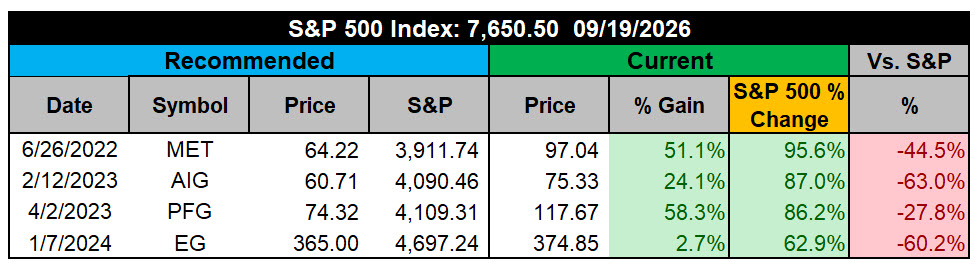
All four of these positions are in the green, averaging a 34.1% gain, and all four are trailing the S&P 500 by an average of 48.9%. None of them carries a 1-year analyst target that beats the S&P’s projected 1-year gain of +20.6%: MET at 10.2%, AIG at 16.8%, PFG at negative 2.3%, and EG at 7.6%. So based on the numbers alone, all four fail the screen for “will beat the S&P 500.”
They’re a Hold anyway, and the reason is the way insurance companies earn their profits rather than anything in those target numbers.
The Fed raised rates on September 16 to a 3.75%–4.00% range — unanimous, 12-0, and the first increase since July 2023 — with projections for another hike in 2026 and at least one in 2027. The 2-year Treasury at 4.67% implies roughly 75–80 basis points of further tightening, more than the dots themselves. The long end is where it matters for these companies: the 10-year at 4.94% and the 30-year at 5.29%, on a normally sloped curve. That’s the best reinvestment and spread environment life and P&C insurers have had in two decades. That’s where they make their money — on the spread.
More importantly, it looks durable. The Atlanta Fed’s GDPNow has Q3 running at 5.1% as of September 17, with the consumer spending component now cast at 4.1%. Headline CPI at 3.4% will fall when energy normalizes — energy is up 16.3% year over year and gasoline 27.4%, which is the entire gap between headline and the 2.4% core. But shelter sits at 3.0% and reaccelerated in August while residential investment contracts at −4.7%, meaning no new supply is arriving to relieve it. A Fed looking at 5% growth and sticky shelter doesn’t stop hiking because gasoline got cheaper.
That combination — hot growth, a restrictive Fed, elevated long rates — is the specific environment where insurance outperforms a growth-concentrated index. Rising discount rates compress long-duration equity multiples, which is what most of the S&P 500 now is. These four sit on the other side of that trade. And the analyst targets above are stale composites, most of them set before the September 16 hike, so the “% to target” figures likely understate all four.
What differentiates each:
MetLife (MET)
- Forward EPS of $10.92 against $5.22 trailing is the steepest earnings normalization of the four, and the resulting PEG of 0.51 is the cheapest relative to growth.
- Post-2017 Brighthouse spinoff, the volatile variable-annuity book is gone. The business is now US group benefits, Asia (Japan and Korea), and pension risk transfer (PRT) — taking over corporate defined-benefit pension obligations for a lump sum, then earning the spread between long-bond yields and what’s owed to retirees. That last piece is long-duration spread income priced off the 30-year, which is why the rate environment matters so much here.
- A 4%-consumer economy means strong employment, which drives group benefits premium growth and keeps credit pristine in the corporate bond and commercial mortgage portfolio.
- Honest negative: pension risk transfer faces structural headwinds, not just cyclical ones. A badly underfunded plan pays roughly $862 per participant annually in Pension Benefit Guaranty Corporation premiums — the federal insurance backstop for private pensions — which gives sponsors a powerful reason to hand the obligation to an insurer. A fully funded plan pays just the $111 flat rate. Rising rates have improved funded status across corporate America, cutting that saving by about 87% and removing the main economic driver of these deals. Litigation over how sponsors select annuity providers has also paused the largest transactions.
American International Group (AIG)
- At 16.8% to target, it needs the least help of the four to clear the 20.6% bar.
- Forward P/E of 8.57 sits below its own five-year median near 10.1 and the industry’s ~9.4 — multiple reversion alone is meaningful upside before any earnings growth.
- Combined ratio of 87.3% in Q1 and roughly 89% in Q2 reflects real underwriting discipline, not just favorable pricing.
- Returned $1.7 billion in the first half of 2026 ($1.2 billion in buybacks, $504 million in dividends), raised the dividend 11%, with $2.6 billion of authorization remaining — investor friendly.
Principal Financial Group (PFG)
- The only one of the four where consensus implies a decline, with a $114 median against $116.17. That’s a consensus positioned for a far weaker economy than GDPNow is currently showing.
- Revenue is the most directly GDP-levered of the group: asset management fees scale with Assets Under Management (AUM), retirement contributions scale with payrolls and wages.
- The Beam Benefits acquisition closed in September 2026, adding employee benefits distribution across 25,000+ small businesses — a hot small-business economy is the best possible integration backdrop.
- Analyst dispersion is unusually wide, with Raymond James at Outperform and a $121 target against the $114 median; the split itself signals low consensus confidence.
- Recent results showed net income up 36.8% and EPS up 41.6%.
- Highest dividend yield of the four at 2.89%.
Everest Group (EG) — the one that doesn’t depend on the macro call
- The $4.74 billion buyback authorization stands against roughly $9.7 billion of float market value — close to half the company, and the largest mechanical capital-return lever here by a wide margin — very investor friendly.
- Cheapest of the four on both measures: 0.93x book and 6.22x forward earnings.
- Deliberately leaning further into catastrophe reinsurance, alongside the Annapurna Re launch, which brings in outside capital providing fees, capital relief, and scale in exchange for giving up a share of underwriting profit.
- Potential downside: a bad hurricane season overwhelms every other item in this write-up.
Bottom line: Hold, not Buy. The environment supporting these four is real and currently observable in the data, and the analyst targets haven’t caught up to the September rate move. But this is fundamentally one macro bet expressed four different ways, which makes the position more correlated than four names in four business lines would suggest. The trigger to revisit is straightforward: if core inflation rolls toward 2% or GDPNow converges back to trend, the Fed stops, the curve flattens, and all four lose the same engine at the same time. EG is the partial exception, since its outcome turns on hurricanes rather than on the Fed.
Have a great week!