
Value Pick – June 7, 2026
Value Pick of the Week
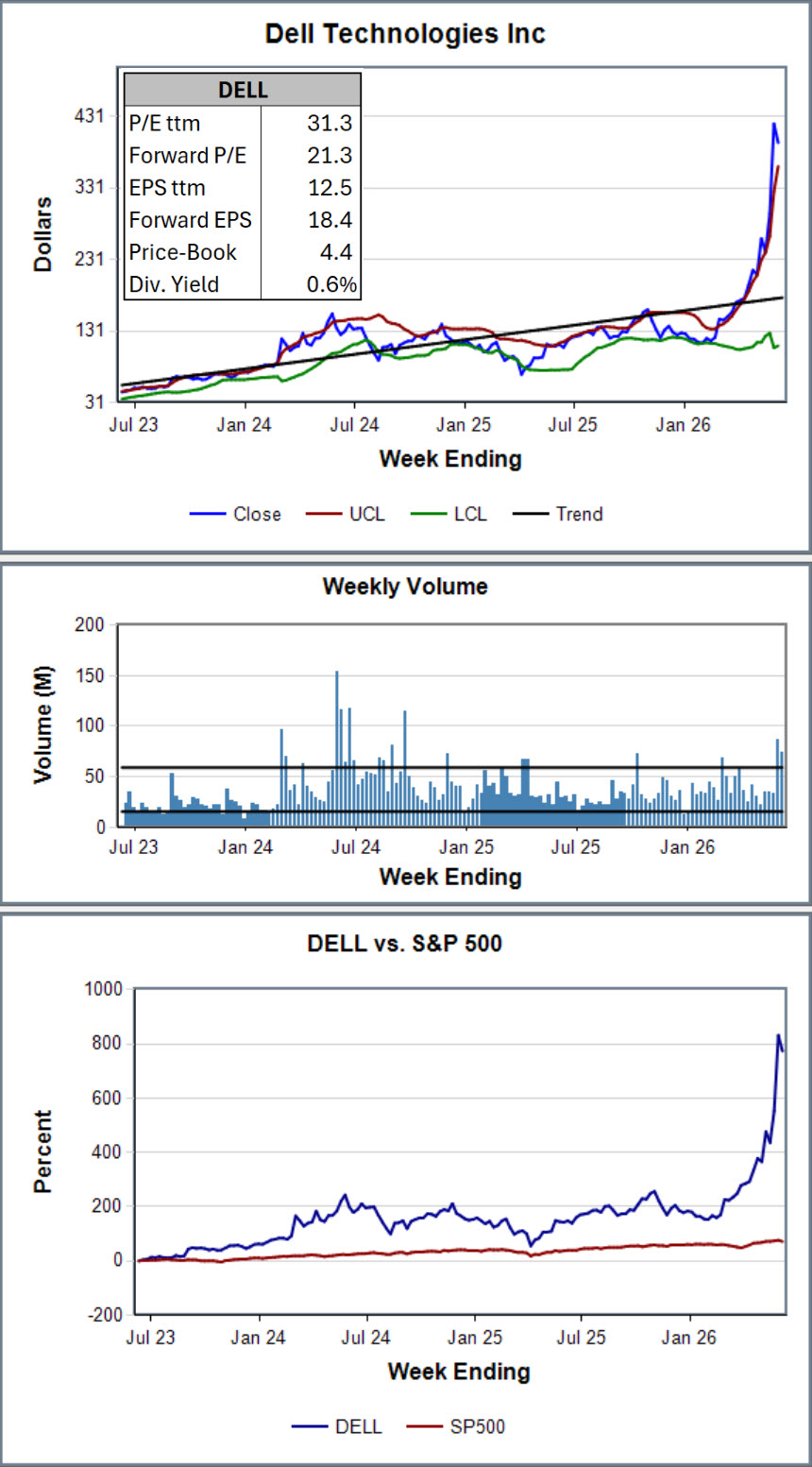
Dell Technologies (DELL) — Dell has already had a stellar run this year (up over 150%) and I think it has plenty of upside potential. It took a breather from its upward climb last week, dropping 12.7%. The combination of last week’s price drop and the prior week’s stellar earnings report brought Dell into the realm of being a Value Pick — the P/E Ratio is a primary component of being considered a “Value Pick.”
- Q1 FY27 revenue beat estimates by 22.58%, EPS beat by 63.99%, and AI-optimized server revenue exploded 757% — one of the most dramatic single-quarter beats in recent memory.
- Management raised full-year FY27 revenue guidance 47% year-over-year, with EPS guidance up 74% YoY.
- Free cash flow surged 357% to $8.555 billion in FY26, funding a 20% dividend hike and a $10 billion buyback expansion.
- Dell reported a total committed backlog of $51.3 billion — contracted future revenue that provides unusual earnings visibility.
- While the current TTM P/E of 31.3 is technically out of range for a Value Pick, the Forward P/E of 21.3 is well inside Value Pick territory, and the Price/Earnings-to-Growth (PEG) Ratio of 0.77 supports the Value Pick thesis (1.0 = fair value). For more information on the PEG Ratio, see Investopedia.
Market Summary
The S&P 500 looked like it was on track for its tenth consecutive weekly gain right up until the market opened on Friday — then it had its worst single day since April 2025, falling 2.6% for the week and snapping the longest winning streak since 1985.
- The nine-week winning streak ended — all of the week’s losses came on Friday, ending a historic run.
- Semiconductors led the selloff — Broadcom (AVGO) upgraded its chip targets, and news of Meta Platforms (META) offering a secondary stock offering made the market jumpy, triggering a broad drop in the tech sector.
- A “good news is bad news” jobs report triggered the damage — the May nonfarm payrolls report showed 172,000 new jobs added, roughly doubling the consensus expectation of 85,000, with unemployment unchanged at 4.3%. The massive upside surprise pushed Treasury yields sharply higher and raised fears the Fed may need to hike rates.
- The VIX fear index surged — the Cboe Volatility Index (VIX) jumped 34% higher on Friday, finishing above 20 — a clear signal that investor anxiety spiked sharply heading into the weekend.
How Our Past Picks Fared
Our past picks outperformed the market this week, gaining 3.3% versus the S&P 500. While we have plenty of tech companies in our list, they don’t account for 40% of the mix.
📉 Ford (F) fell 14.6%
- April U.S. sales had already fallen 14.4% year-over-year to 178,667 vehicles, with electrified vehicle sales down 31.1% and internal combustion models down 11.8% — the May report continued that weak trend.
- The stock had run from roughly $11.50 on May 4th to a recent high near $17.78 — a 45% gain in under a month — and the Ford Energy narrative had clearly gotten ahead of the underlying fundamentals.
- The Ford Energy story remains intact — the EDF framework agreement and Morgan Stanley’s $10 billion valuation thesis haven’t changed — but the market needed a reality check on the core auto business before repricing further upward.
📉 Tesla (TSLA) fell 10.3%
- The broad tech and semiconductor selloff on Friday hit high-valuation growth stocks disproportionately hard, and Tesla — trading at a premium valuation despite declining EV deliveries — was squarely in the crosshairs.
- A significant overhang heading into the week was the upcoming SpaceX IPO on June 12th — analysts flagged that when SpaceX goes public, Tesla investors may rotate capital out of TSLA and into SpaceX directly, since much of Tesla’s premium valuation has been driven by belief in Elon Musk’s broader vision rather than Tesla’s standalone EV fundamentals.
- Tesla announced it was ending production of the Model S and Model X — Musk confirmed on X that orders for both models had come to an end, closing out an era for two of the company’s longest-running vehicles and adding a negative sentiment layer.