
Blackjack Betting Systems & Myths
Blackjack Betting Systems
In order to assess the various betting strategies, we tested each system using the same set of shoes. The player being tracked played exactly the same way on every hand, and the wins, losses, pushes, doubles, and splits were also exactly the same. The only thing that changed was the betting strategy. Other parameters:
- Six-deck shoes
- 6-Deck Strategy Table
- Table maximum bet set at 20 Units (20× table minimum)
- Pushes are ignored
- The system being tested was reset at the beginning of each shoe
- Three players at the table, including the player being tracked at First Base
The Baseline
Our baseline for these tests is a bet of 1 Unit on all hands using the 6-Deck Decision Table — 100 groups with 400 hands dealt in each group.

Obviously, any betting strategy must improve on this.
We looked at eight betting strategies. If I’ve missed one of your favorites, please let me know.
- Martingale
- 2-1-2 Manhattan
- Oscar
- Paroli
- Parlay
- 1-3-2-6
- Labouchere
- Rouse House (my own system)
The Systems
The Martingale System
The Martingale System involves doubling your bet every time you lose, with the premise that at some point you’re going to win and recover your previous bets. If there were no table maximums and you had an unlimited bankroll, this system would work over 80% of the time.
The 2-1-2 Manhattan Strategy
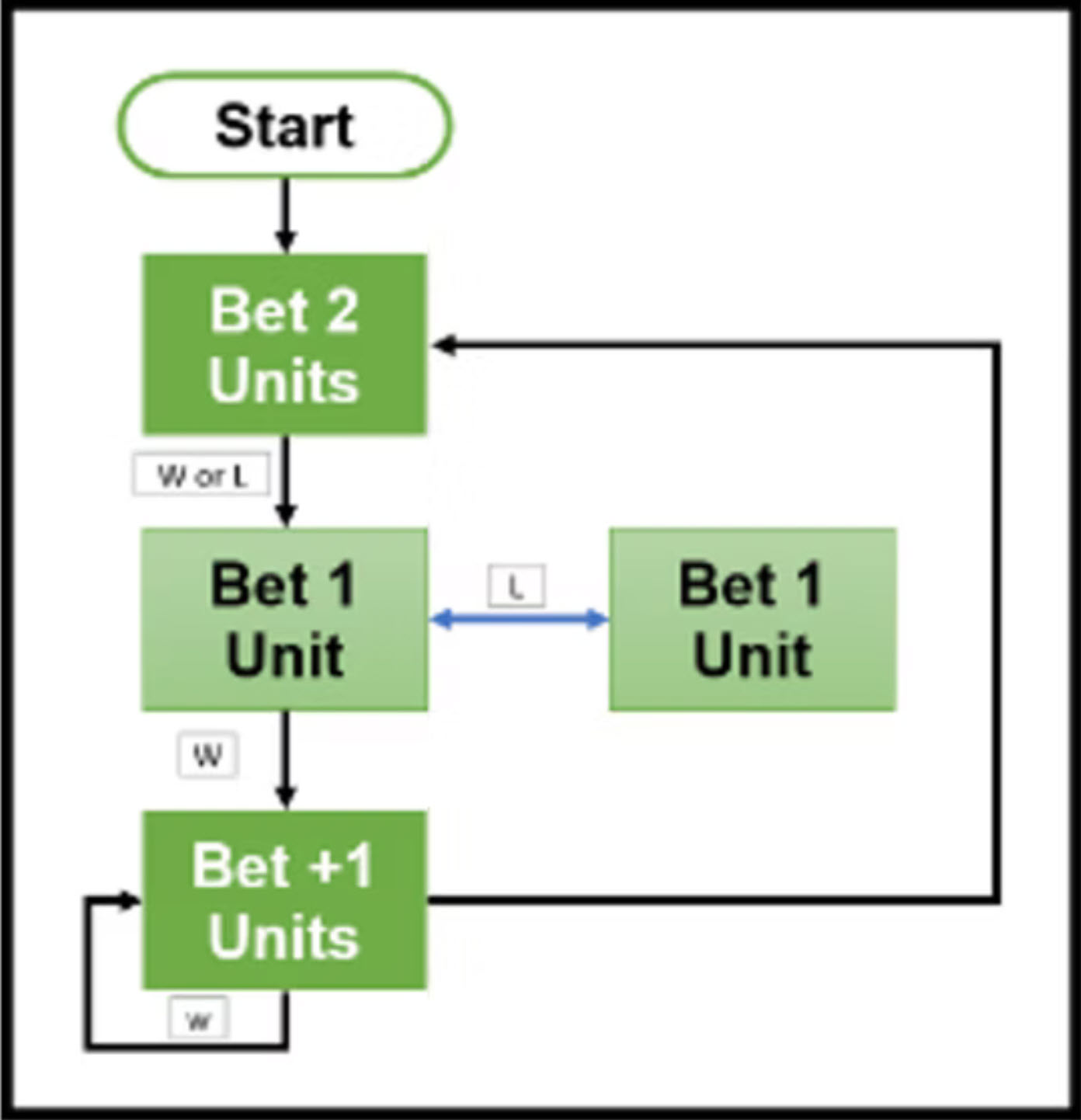 The 2-1-2 Manhattan Strategy (212 is Manhattan's area code) tries to take advantage of a hot streak without giving everything back. The idea is that you start with a 2-unit bet, then — win or lose — reduce your bet to 1 for the 2nd hand. If you win, increase your bet to 2 and increment your bet by 1 unit after each consecutive win. If you lose the 2nd hand, stay at 1 unit until you win, then increment your bet. Once you've increased your bet to 2 or more, start the cycle over again with a bet of 2 units when you lose.
Oscar’s System
The goal of this system is to win 1 unit per series. You start at 1; if you win, add 1 to your bet. If you lose or push, keep your bet the same. Keep doing this until you’re up 1 unit, then go back to a 1-unit bet and start the series over. Keeping track of two different “banks” complicates things, but not too badly. Most systems are dependent on the outcome of the previous hand, independent of the cumulative bank. The effect of double downs on “Oscar’s Bank” was included in the determination of whether the goal of being up 1 for the series had been met.
Paroli System
The Paroli System increases your bet when you win, up to a pre-determined maximum bet. You start with 1 unit. If you win, increase your bet by 1 unit. Go back to a 1-unit bet when you lose or have just won your maximum bet. We set the maximum bet at 5 units.
Parlay System
Also known as the “Anti-Martingale,” this system has you double your bet each time you win. If you lose, go back to a 1-unit bet. Easy.
The 1-3-2-6 System
As you may have guessed, the name implies the betting strategy. If you were to win four hands in a row, your bets would be 1 unit, then 3, then 2, then 6. If you win all four hands in the cycle you will have won 12 units. If you lose at any time, go back to betting 1 unit.
The Rouse House System
This system is predicated on the concept that any good hot streak is going to include the dealer busting. It’s pretty simple. Start at 1 unit. If you win and the dealer busts, increase your bet by ½ unit. If you lose, drop back down to 1 unit and begin again.
The Labouchere Betting System
The Labouchere system is included here only to mention that we’re aware of it. It’s a complicated system whose description starts with, “begin by writing down a group of numbers.” The group of numbers expands by one number when you lose, and contracts by two numbers (the first and last) when you win. Most casinos won’t let you have your cellphone out at the table, let alone a pencil and paper. If you’re good enough to track this system in your head, use a card counting system.
The Results
None of the systems won over the course of our 100 groups of 400 hands each. It’s impossible to beat the fact that the player goes first, and if you bust, you lose even if the dealer busts.
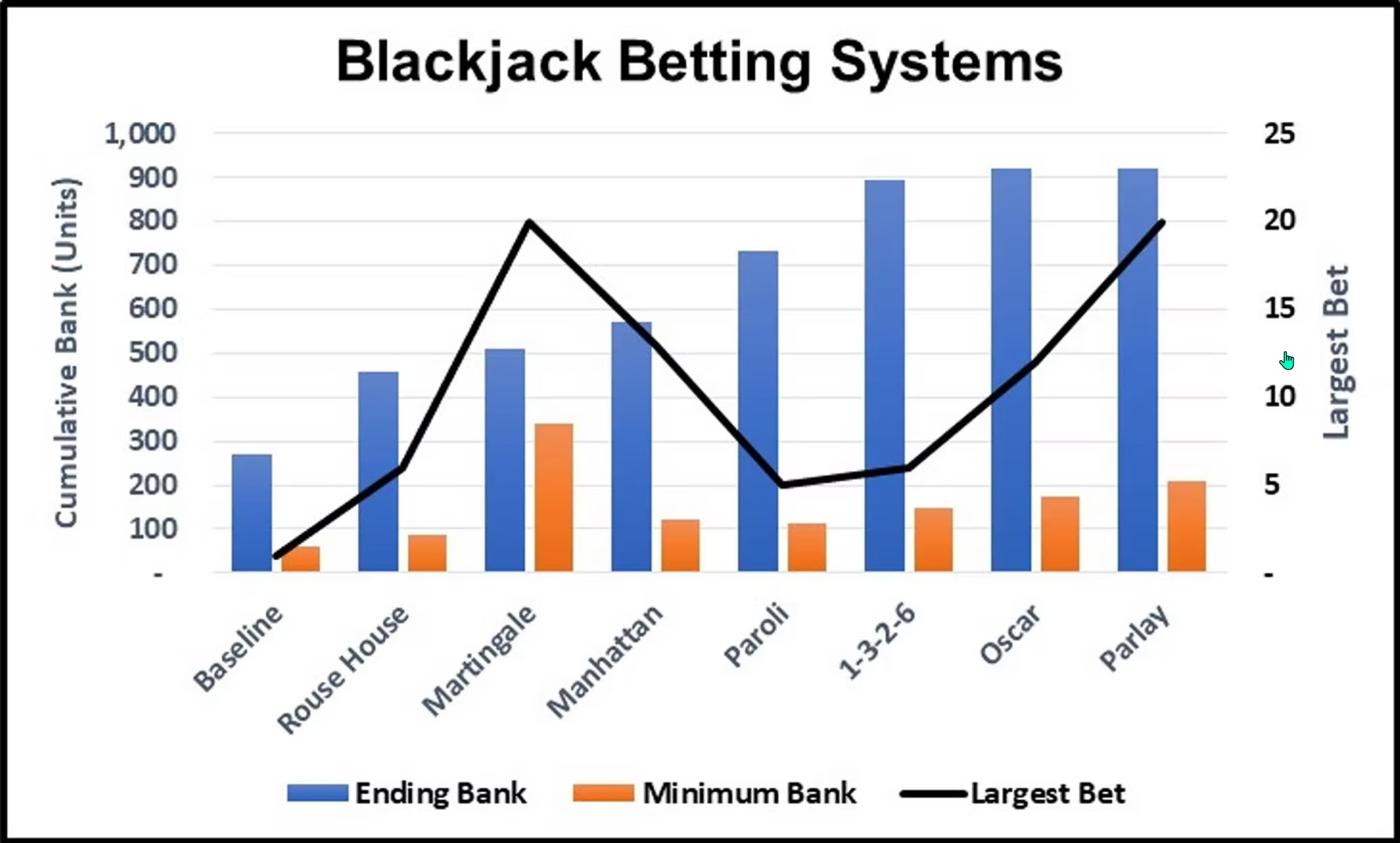
Shorter bars on the graph represent lower losses. The blue bars track the total units lost over the course of the entire 100 groups. The orange bars track the lowest point your bank reached during any group (how much you would need in your bankroll to play the system). The black line shows the largest bet on any individual hand — both the Martingale and Parlay systems topped out at the table max of 20 units.
We looked at it from the point of view of which system loses the least.
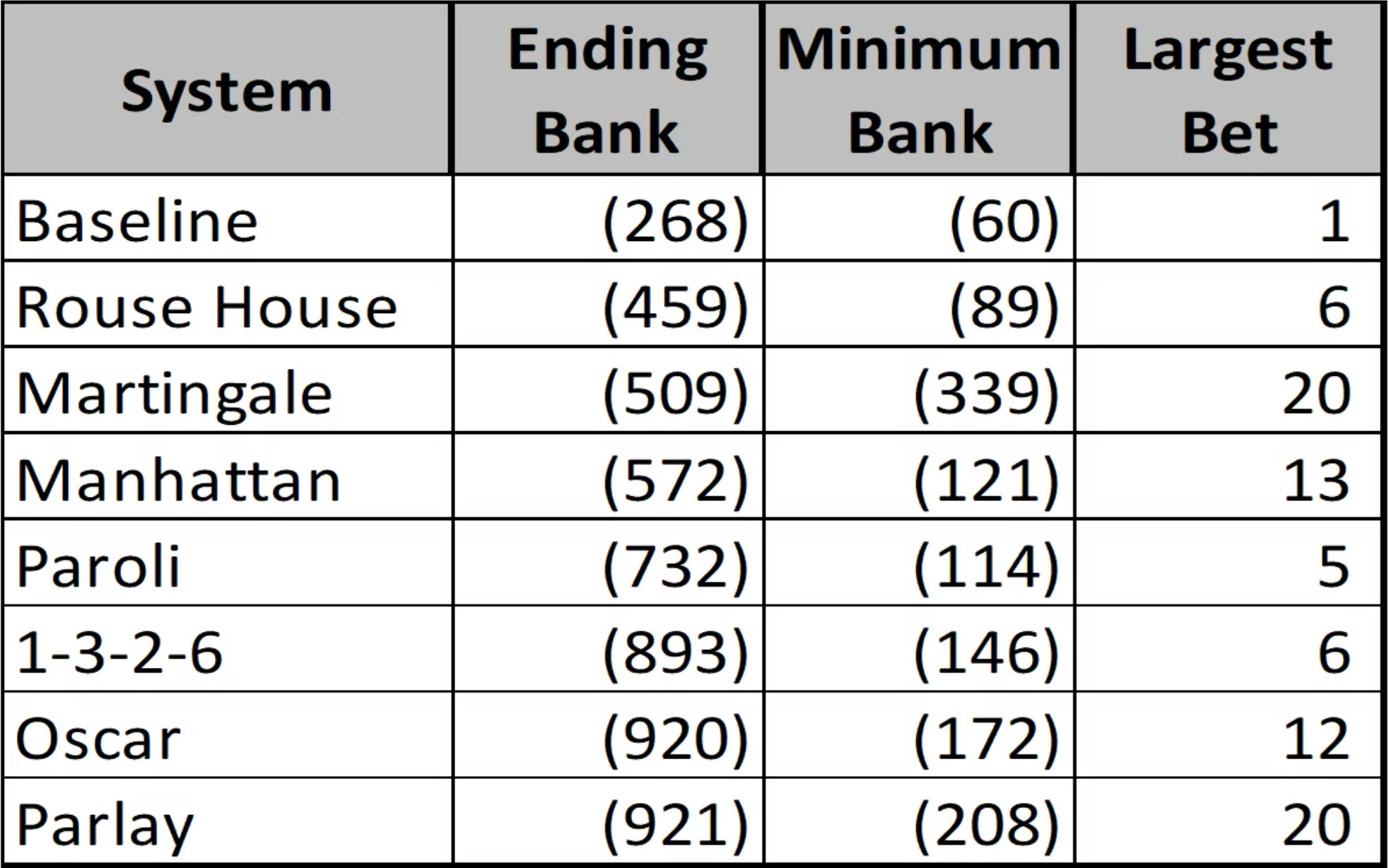 None of the systems beat the baseline. The Rouse House system came in 2nd place by virtue of wagering the second-lowest amount. Martingale — the only negative betting strategy (increase the bet when you lose) of the eight — came in 3rd and deserves some more attention, since it was the only system that won more groups than it lost: 54–46, even though it lost overall.
When testing the Martingale with no table limits and treating each group as if it were one huge shoe (no reset at the start of a new shoe), you would have won 92 out of the 100 groups. For our discussion we’ll convert 1 unit to equal $25 to emphasize the huge amounts required to play this system effectively. If you could find a $25 table with a $2 million table max, you would have made $872,825 on our sample shoes. At one point you also would have placed a single bet of $1,638,400 with your bank at minus $1,587,200. You would have needed to buy in with about $3.5 million.
Normally a betting strategy resets at the start of a shoe, and the Martingale would have won 84 out of 100 groups and reduces the bank requirements considerably. Resetting at the start of each shoe “only” requires a $25 table with a $100,000 max and a $135,000 buy-in. The largest individual bet would have been a mere $51,200 with your bank at -$79,738. Still too rich for most people. Your winnings would also suffer, dropping to $493,425.
Table limits are what cause the Martingale system to fail. If you’re at a table with a $500 table max you reach the limit anytime you lose more than 4 in a row, which happens frequently. Instead of betting $800 on the next hand, you’re limited to $500 and you’re $300 behind even if you win. The player lost 12 hands in a row at least once, putting you $4,275 down for the streak. The ending bank balance for the groups averaged -$127 and ranged from -$7,900 to +$5,700. Even if I was willing to lose $12,725 over the course of our theoretical year, I’m not sure I could handle the massive swings — my system can only handle so much adrenaline.
Quit On a Bad Day
One strategy that never seems to get much attention is the “Quit On a Bad Day” strategy, where you decide it’s not your day and leave. Looking at the won/lost numbers from the Six Deck analysis it was clear that there was a significant difference from one group to another, and the average losing group lost 31.9% more than the average winning group won (-1.68 units vs. +1.27 units). We looked at what would happen if you limited your losses to 20 times the table minimum on any given group. This concept changes the number of hands played, so it’s not directly comparable to the previously discussed data sets.
We’ll use a bet of 1 unit on all hands as our baseline:

The obvious downside to the strategy is that you play 24.5% fewer hands, which translates into less entertainment at the very least. Converting the losses to Defects Per Million Opportunities (DPMO) — where a loss is a defect and a hand dealt is an opportunity — the original baseline was at 6,494 DPMO. Quitting early increased the DPMO to 6,961. If maximizing your entertainment is the goal, then this is not the strategy for you. Put another way, the average group playing all the hands was -5.43, 95% CI (10.08, 0.78), and the average for the abbreviated groups was -4.14, 95% CI (-8.00, -0.28). Statistically there’s no difference between quitting early and playing all of the hands, so have a good time. See the article, “Six Deck Blackjack & More” for more information on statistical analysis.
When combined with a betting strategy, things look different:
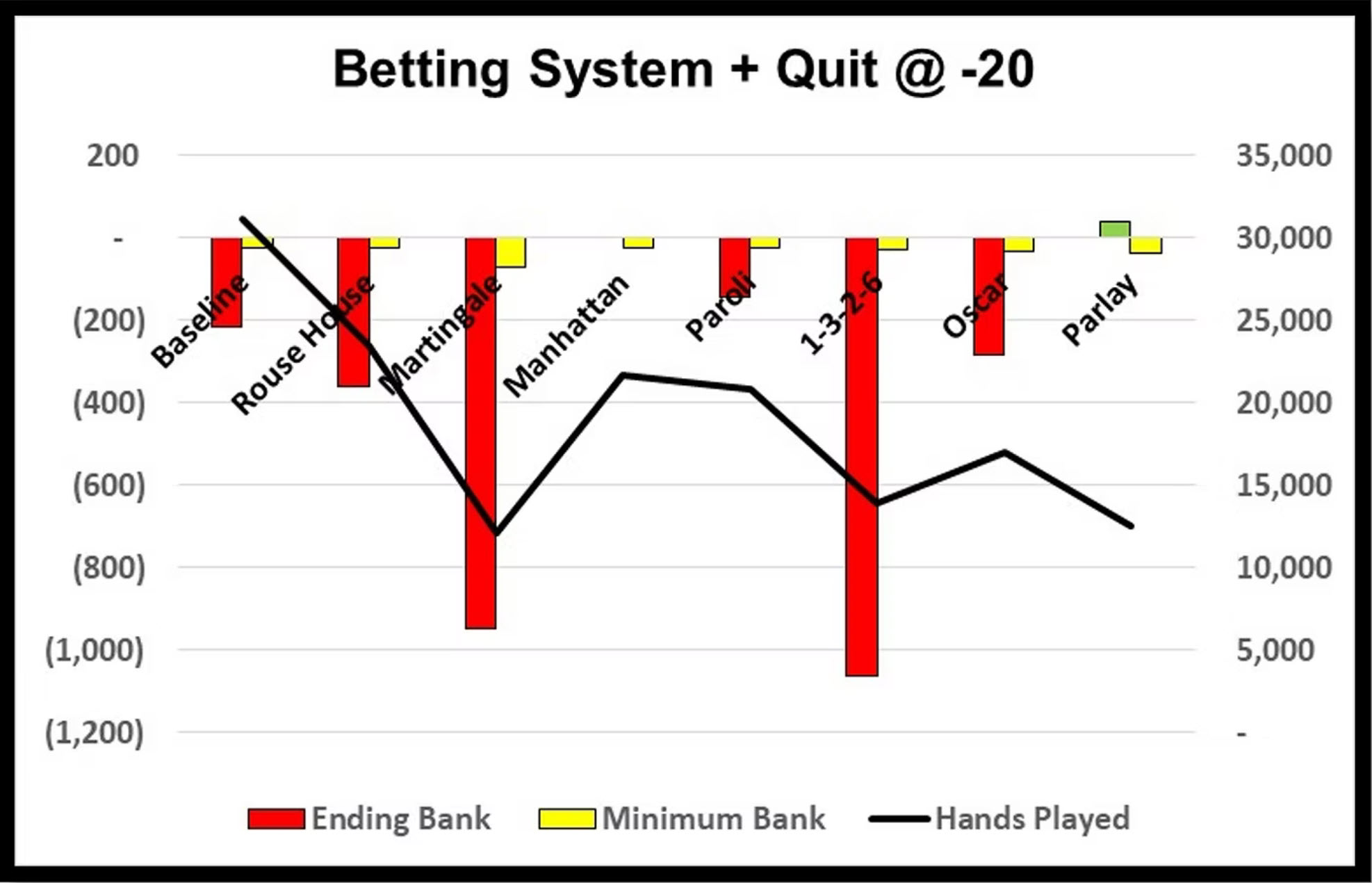
The Manhattan Strategy broke even and the Parlay system was up 39 units. Both of those came at a significant reduction in the number of hands played.
If you’re planning on limiting your losses by quitting early, I wouldn’t use the Martingale or 1-3-2-6 strategies since both reduce your entertainment by more than 65% and had the highest losses.
The Parlay was a winner with these shoes, but it came with a reduction of 70% of the hands played and was a feast-or-famine approach. 82 of the 100 groups lost an average of 20.9 units playing an average of 67 hands — about $550 in 45 minutes at a $25 table. It won overall because when the system won, it won big. All of the possible hands were played in the 18 groups that won, with an average win of 104.2 units ($2,605 at a $25 starting bet), with a range of 25 to 214 units. The cumulative bank bottomed out at -175 and hit a high of +694 (-$4,375 / +$17,350 at a $25 starting bet). This looks like a good system for the adrenaline players who don’t mind an early night.
The Manhattan System broke even and had wild swings in the cumulative bank. It won 25 of the 100 groups and, like the Parlay System, won big when it won.
Pick your poison and accept that you won’t beat the house over the long haul.
Myths
First, I’d like to dispel a superstition that there’s a “best” number of players at the table. It doesn’t matter.

One million hands were played with 1 to 6 players at the table. The winning percentage was within 0.1% for wins excluding pushes (Wins / (Wins + Losses)), and regardless of the number of players at the table the results were the same for wins including pushes (Wins / Hands Played). We do recognize the concept of “Good Shoe/Bad Shoe” — a concept that was confirmed in the 8-Deck Blackjack analysis — and know that if you’re alone at the table and you’re in a bad shoe, it’s time to move to a different table.
Bad Players
Second, we’ve all seen the player that stays with a 15 against a dealer face card, then on the next turn hits a 14 against a dealer 6.
 The standard group of 100 sets of 400 hands was run (40,000 hands plus splits). Once with all three players playing according to the 6-Deck Table, then again with the player at 3rd Base randomly hitting or staying when they had a 12–16 and the dealer had an up card of 7 or better. In our test, the player at 1st Base was tracked and they lost a total of -414 Units (at a starting bet of 1 on each hand) with everyone playing by the table, and lost -339 Units with the "Bad Player" at 3rd Base. Ignore them — they don't matter unless they're splitting faces.